
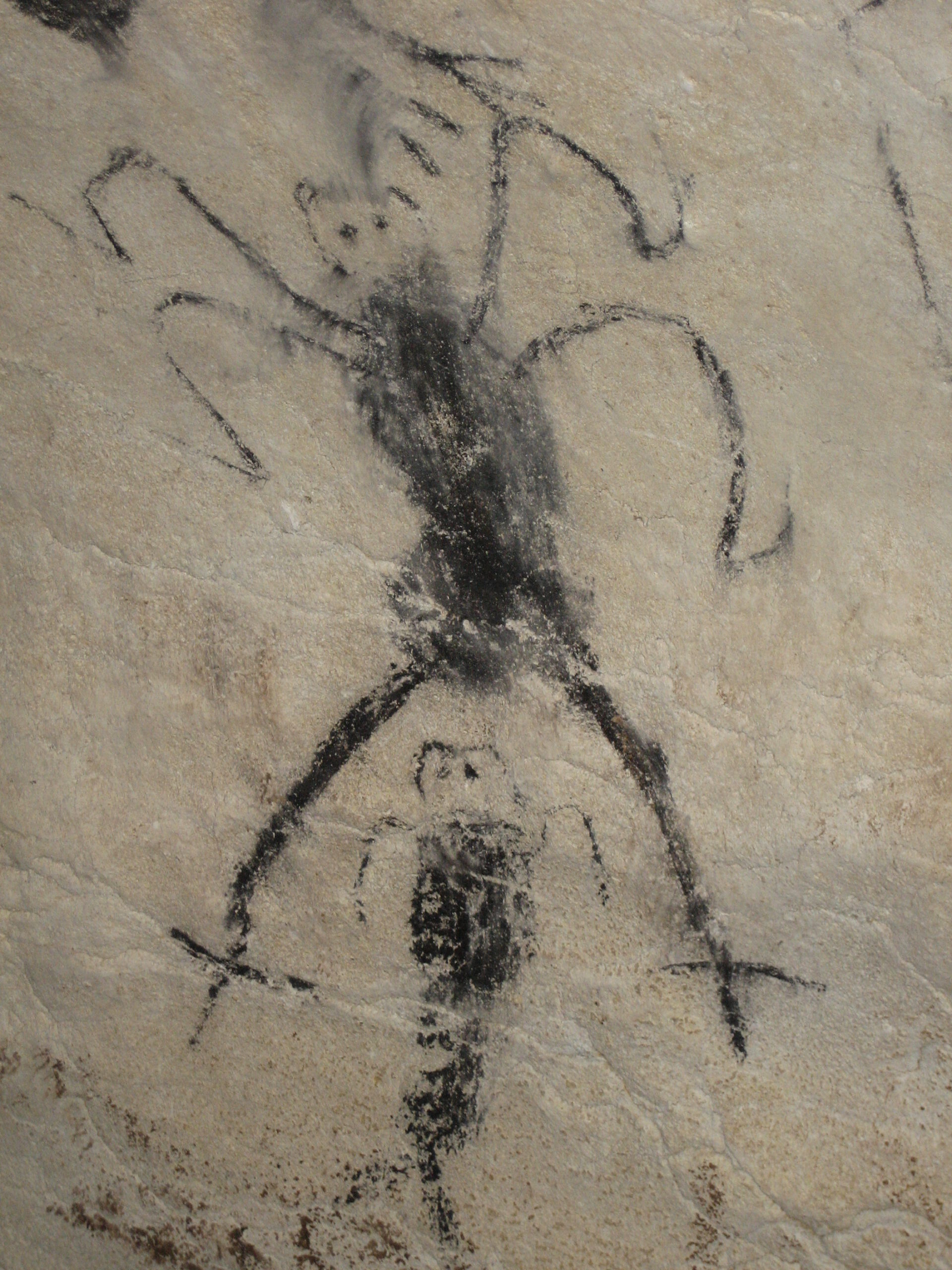
On 9 August 2005, we organised the celebration of the International Day of Indigenous Peoples (IDIP) for the first time in the Dominican Republic (DR).
The event was recorded and can be viewed here as a single video, or, if you prefer, you can watch the five parts separately:
- Opening presentation by Fátima Portorreal and Mon González
- Talk on archaeology by Gabriel Atiles and Adolfo López
- Talk on ethnogenetic heritage by Tony de Moya
- Talk on femininity by Mon González
- Closing concert by Irka Mateo
For that occasion, I prepared a lecture entitled ‘The Feminine in Taíno Culture’, which I delivered again in the DR in October of that year, and in London in March 2008.
Following the IDIP event, I wrote a summary which was published in the Listín Diario newspaper.
For this web post, I have compiled the summary set out below, to which I have added a bibliography.
The Feminine in Taíno Culture:
religion, mythology, society, sexuality, history, poetry and magic
On the island of Hispaniola, shared by the Dominican Republic and Haiti, before the arrival of the Spanish, women and the feminine were present in many aspects of daily life and spiritual experience. With the discovery, a patriarchal worldview took hold, which relegated the memory of that feminine aspect to the background.
The following text attempts to recover some elements of that lost feminine dimension. The exposition begins with a brief introduction to the name of the island and the Taíno word; it is divided into six parts: religion or deities; mythology; pre-colonial Taíno society; sexuality; history; poetry and magic.
Introduction
The present-day island of Hispaniola had two names during the Taíno period. Around 1556, Pedro Martir de Anglería attributed the name ‘Quizqueya’ (or, had they had a written language, it might have been spelled ‘Kiskeya’) to this island; in Taíno, this meant ‘the greatest thing, with nothing greater’, ‘greatness’, ‘the universe’, ‘everything’, like the Greek god Pan. For his part, the great Dominican writer and historian Emilio Tejera, in his work “Indigenismos”, attributes to the island the name Haiti (or, in its spelling, perhaps Ayití), which in Taíno means ‘high land’. “Indigenismos” is the most comprehensive dictionary of the Taíno language in existence, comprising 1,383 pages. In my opinion, Kiskeya—a female name—was indeed the original name of this island. Over time, following incursions by other peoples and, above all, after the arrival of the Spaniards, the Taínos began to “flee to their mountains”—those that sheltered the last great rebel, Guarocuya—and the name Ayití came to prevail.
Tejera defines the term ‘Taíno’ as ‘a man of good character. Good […] Today, this term is used to refer to the Antilleans of Arawak descent and to their language. Professor Félix Pérez Sánchez states that ‘it is an ethnological error to call the Arawaks “Taínos”’. In fact, no ancient author applied that term with such a meaning, but today its use is so widespread […] that it has become established despite being an obvious error’. The word ‘Taíno’ also exists in other indigenous cultures of the Americas. In Guaraní, one of the languages of the Amazon region, also belonging to the Arawak family, ‘taihin’ means ‘people of a certain race’ or ‘people of a certain lineage’, and in Aymara, the language of the Amerindian people living around Lake Titicaca, it means ‘first-born’. ‘Taíno’ was not, therefore, the name of the indigenous people who inhabited this island, but rather a simple word in their language meaning ‘a good person’.
Nevertheless, it is the magic born of the forgetting of factual details that leads us to call them Taínos—that is to say, good people. The Dictionary of the Spanish Language defines ‘aboriginal’ as ‘native to the land on which they live. It refers to the original inhabitants of a country, as opposed to those who settled there later’. The Taínos were, therefore, the aboriginals of the island of Ayití, later known as Hispaniola, which was subsequently divided into two countries.
Fray Bartolomé de las Casas, who arrived in Ayití in 1502, wrote: “…they are such a loving and unselfish people, and so well-suited to everything, that I assure Your Highnesses that I believe there are no better people or a better land in the world; they love their neighbours as themselves and speak in the sweetest and gentlest manner in the world, always with a smile”.
1. Religion
The deities of the primitive religion in Ayití (by ‘religion’ we mean ‘the body of beliefs or dogmas concerning the divine’) have come down to us through the legacy of the Catalan Hieronymite friar Ramón Pané, who arrived in Ayití on Columbus’s second voyage (1494), in his brilliant little treatise “Relación acerca de las antigüedades de los indios” (“Account of the Antiquities of the Indians”), which is the first ethnological compendium written in the New World. Among subsequent studies on this subject, those by the great Cuban structuralist linguist José Juan Arróm are particularly noteworthy, especially his ‘Pre-Hispanic Mythology and Arts of the Antilles’ (1975).
Pané notes in his preface that the supreme god is called “Yucahu Baguá Maórocoti”. He says of him that “they believe he is in heaven and is immortal, and that no one can see him, and that he has a mother, but no beginning”. On the one hand, there is Yocahú, who is the Spirit of the Cassava. On the other hand, Baguá—which is the name the Taínos gave to the Caribbean Sea—is the Spirit of the Sea. The most curious thing is that the Taínos did not stop there; rather, in defining their principal deity, their cosmogony went further than that of Westerners or the Chinese by introducing a final nuance into their concept of the Great Spirit. This nuance is achieved through the addition of the term ‘Maórocoti’, which comes from ‘ma’, meaning ‘without’, and ‘órocoti’, meaning ‘grandfather’, according to Arrom’s translation; this literally means ‘without grandparents’, that is to say, the force of matrilineality. Thus, the Taínos incorporate into the immanent Great Spirit—the supreme deity found in the cosmogony of all indigenous American cultures—an explicit recognition, right in its very name, of their primordial feminine principle rather than the masculine one, which is gradually being lost over time.
Yocahú’s mother was Atabey. Pané states that “his mother [Yocahú Baguá Maórocoti’s] is called Atabey, Yermao, Guacar, Apito and Zuimaco, which are five names”. As the Puerto Rican professor Jalil Sued-Badillo points out, “the mother of the chief god […] has five names; the son only three”. In Taíno society, according to this professor, the number of names acquired during one’s lifetime reflected important mechanisms of social differentiation. Hence, it can be inferred that, for the Taínos, the Mother Goddess was more powerful than her son. These names, according to various translations, would make this Goddess the Goddess of the Waters, She Who Is at the Origin, The Weaver, Our Moon (Force of the Tides), and The Benevolent One. She is, therefore, the Goddess who watches over birth, water, the moon, the tides, our menstruation and the weavers. In the Yoruba culture and language of the African slaves who came to this island in the 16th century, this deity would be equivalent to Yemayá.
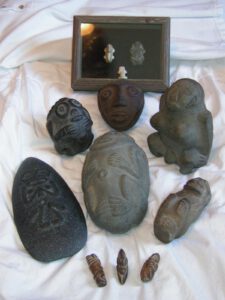
Whilst Yocahú, from an archaeological perspective, is mainly associated with trigonolites, Atabey appears in a wide variety of representations linked to a multitude of functions: general rituals such as stone cemíes for altars, duhos or belts; rituals linked to the specific rite of the cohoba, such as vomit spatulas or inhalers; ornamental items such as necklaces, amulets and stamps for body painting; and items related to fertility, such as trigonolites, phalluses or stones used in childbirth. Likewise, Atabey is associated with numerous animals such as the frog, the snake, the inriri, the iguana and the owl, all of which are linked to fertility, life or the life-death-life cycle. The following image shows various representations of Atabey photographed in Miami from Alfred Carrada’s private collection.
Guabancex is the Lady of the Winds. Pané devotes Chapter XXIII to Guabancex. He describes her as a female cemí who, when “she becomes enraged, stirs up the wind and the water, and brings houses crashing down and uproots trees”. Arrom points out that “it is well known that towards the end of summer and the beginning of autumn, hurricanes form—which today, due to a strange misogyny, have come to be identified by women’s names […] And the Taíno, by a curious coincidence, also identified them as the work of an angry female deity whom they called Guabancex”.
These would, in my opinion, be the three main forces of the Taíno trilogy.
Hinduism, the religion of the Vedic civilisation that became established in the Indus Valley around 1,200 BC – curiously, the same date suggested by the 2005 archaeological discovery at Bayahíbe for the civilisations that settled in Ayití – also had a trilogy of forces at the pinnacle of the sacred: Brahma, Vishnu and Shiva, who embody three forces: creation, preservation and destruction. Here we might draw a brief parallel. The creative force would be the feminine (Brahma, Atabey), the preservative force would be the masculine (Vishnu, Yocahú) and the force of destruction would be the task of the neutral energy (Shiva, Guabancex) . This third force could be the one within which to place gay men and lesbians; in other words, it would be a sub-force under the protection of the feminine, born with the task of transforming outdated pre-existing paradigms.
2. Mythology
Taíno mythology (by ‘mythology’ we mean ‘a wondrous narrative set outside historical time and featuring characters of a divine or heroic nature’) is extremely rich. With regard to the feminine, it is worth highlighting, on the one hand, the myth of the creation of woman and, on the other, the myth of the ciguapa.
The myth of the creation of woman could be reconstructed from Chapters II, VII and VIII of Pané and the interpretations of the Puerto Rican scholar Ricardo Alegría as follows:
Once upon a time, there was a great Taíno named Guahayona, who was upset because a man he had sent to gather the herb called ‘digo’ had not returned. So, Guahayona decided to leave the Cacibajagua cave and said to the women: ‘Leave your husbands and children behind, and let us go to other lands’. The women followed him; they all set out from Ayití and, after a long journey, arrived at the island of Martininó, where he left all the women.
The men of Ayití wanted wives and prayed to the heavens for them. One day, whilst they were washing, they saw a certain kind of being falling from some trees, sliding down through the branches; these beings had neither male nor female sex. The men went to catch them, but they fled as if they were eels. They called upon four caracaracoles—people suffering from a disease that made their skin very rough. The caracaracoles caught them. Once they had caught them, they held a council on how they might turn them into women, since they had neither male nor female sex.
They sought out a bird called Inriri, which drills holes in trees. And so, they took those women who had neither male nor female sex, bound their hands and feet, brought the aforementioned bird, and tied it to their bodies. And the bird, believing them to be logs, began its usual work, pecking and boring holes where a woman’s genitals are ordinarily found. And in this way, the Indians say, they came to have women.
Regarding this myth, one might venture to suggest that the story of Martininó is surely a true account which explains why on that island – believed to be present-day Martinique – was home to warrior women who were self-sufficient, perhaps lesbians, who only took men to conceive; and if the children born were boys, they were taken off the island and returned to their fathers. This could be linked to the Greek myth of the Amazons and to Sappho, the great poetess from the island of Lesbos, who lived in the 7th century BC, whom Socrates called ‘the beautiful one’, who was married, had a daughter and founded a sisterhood of women to seek love through refinement. Sappho, and by extension her sisterhood, is the origin of the term ‘lesbian’, a close counterpart to the women of Martininó.
As for the ciguapa, it was Javier Angulo Guridi who first wrote a story about this mythical figure in 1866. Manuel Mora researched this myth with true devotion, and his article on “Indias, Vien Vienes and Ciguapas: News on three Dominican traditions”, published in the magazine EME-EME in 1974, and his novel “Goeiza”, winner of the 1979 Siboney Prize, stand as a testament to this. In 2005, the archaeologist Gabriel Atiles published the following online: ‘Genesis of a Myth. The Ciguapa, 139 Years After Its First Written Documentation: An Analysis of the Perception and Transformation of the Myth’. Atiles stated that ‘the truth is that the Ciguapa is a legend found throughout almost the entire country’; although ‘there is nothing in rock art tradition that tells us about the Ciguapa’.
The myth could be recounted as follows:
The elders say that there are beautiful women, called ciguapas, who are small in stature, with dark complexions and black, almond-shaped eyes; with soft, lustrous hair so long that it is the only garment they wear; with long, slender legs; and with feet turned backwards. Some are even said to be beautifully feathered.
The ciguapas are said to be wild women who possess magical powers, yet are completely harmless and extremely shy – even to the point of being frightened by people. The ciguapas are said to dwell in the mountains, usually in mountain caves, although they might also be found by river pools on new moon nights.
The ciguapas are said to have a hunter’s heart and would venture out at night from the mountain ranges in search either of lard and raw meat or of some night-time traveller to bewitch, love and then kill. If one were to look into her eyes, she would bewitch with her power, and if the man were to respond to her song, he would be lost forever. Encountering a ciguapa could mean being loved in an incomparable way, but it could also mean being torn away from the familiar to enter, forever, the dark, nocturnal world of the ciguapas.
Ciguapas could only be captured with a black-and-white dog, with five-toed paws, on nights when the moon was full.
Personally, I believe that, although Pané’s collection does not specifically mention ciguapas by that name, he may well be alluding to them in the prologue when he says: ‘And they believe that the dead appear to them along the roads when someone is travelling alone; for when many travel together, the dead do not appear to them’. Even back then, that superstition—a fear of the night spent alone and of the unknown—already existed… and over time, this lurking presence took the form of a magical woman… Of course! The magical has always been feminine.
3. Society
Taíno society was a class-based society, much like Hindu society, at the pinnacle of which stood the caciques or cacicas/caciquesas; next came the nitainos; the mass of the people who might be termed Taínos; and, finally, the naborías, who served the rest.
I believe that the concept of social class amongst the Taínos was not based solely on material wealth or possessions. From the little that was actually recorded about them at the time, it can be deduced that strength and spiritual development were important criteria for the natural selection of their leaders and for the stratification of their social classes.
Following maxims attributed to the philosopher of Greco-Egyptian antiquity, Hermes Trismegistus, in the “Kybalion” and, specifically, the ‘principle of correspondence’, which states that ‘as above, so below; as below, so above’, it can be asserted that, just as the gods in Ayití were predominantly female, so too was society predominantly matrilineal.
Dr Marcio Veloz Maggiolo, in his “Prehistoric Archaeology of Santo Domingo”, states that “monogamous marriage and matrilineal succession predominated in Taíno society”. He also asserts that “women bore the brunt of the labour”.
4. Sexuality
Jalil Sued states that: “Fray Bartolomé de las Casas devoted three chapters of his “Apologética Historia” to demonstrating the ‘superiority’ of indigenous sexual customs over those of many peoples in other parts of the world”.
Taíno women had free access to the priesthood, to leadership roles in society and to a free sexuality. The Spanish culture that came to dominate, shaped by Catholic ideology, had progressively closed itself off from this.
By then, the Catholic Church had already dealt three fatal blows to the magical-feminine. Firstly, by excluding women from the priesthood and relegating them to the role of servants of the Church (in the 3rd century, when the Gnostics – a Christian group that accepted both men and women into the priesthood – were deemed heretics) . Secondly, by removing reincarnation or metempsychosis from the Church’s doctrinal corpus, which took place in the year 553 during the Second Council of Constantinople. As reincarnation is a ‘magical’ explanation that transcends what the patriarchal and linear mind can grasp—and is therefore dangerous, as it eluded male control—it was suppressed. Nor should we overlook the fact that one is always born of a woman. Thirdly, the definitive prohibition of priests’ marriage during the First and Second Councils of the Lateran, in 1123 and 1139. By decreeing the absolute separation between sex and the sacred and by demonising sexuality, the West castrated its capacity to flow with and play with sex, thereby creating, fostering and spreading many atypical and unhealthy situations.
By comparing this demonisation of sexuality and its separation from the sacred with the Taino conception, one can better understand the gulf between them. These two vastly different perceptions of the feminine, sexuality and the magical—between the culture that prevailed in Ayití and that which arrived from outside—formed the underlying basis that turned the encounter into a tragic clash of civilisations.
5. History: Anacaona
Unfortunately, there is no rigorous historical research on the figure of Anacaona (or, if there is, I am unaware of it). The great Dominican historian Demorizi does not even include the name Anacaona in any of his indexes. And yet, upon her brother’s death, Anacaona became the chieftainess of Jaragua, the most politically well-structured chiefdom in all of Ayití. Likewise, some believe that upon the death of her husband Caonabó, Anacaona became the chieftainess of Maguana. In the south there was another great female chieftain, Higuanamá. Together, the two held the southern part of the island under female control.
The figure of Anacaona is depicted in historical novels such as ‘Enriquillo’ (1882) by Manuel de Jesús Galván; and ‘Anacaona. The Queen of the New World’ (2003), which the lawyer Fernando Hernández Díaz wrote to honour her on the 500th anniversary of that assassination.
Fernando Hernández recounts how Anacaona fought in the Battle of Jánico and was instrumental in freeing the other chieftains; she was present at the Battle of Guaco; and she was the only one amongst the chieftains – apart from Guacanagarix, who from the outset sided with the explorers– who defended dialogue with the outsiders right to the very end.
Not only has no in-depth and rigorous historical study been dedicated to Anacaona, but she does not even appear in most encyclopaedias. It is sad to see that she is not included, whilst her nephew, Guarocuya, does appear – albeit under his Christian name, Enriquillo. Perhaps this has also played a part: Anacaona never converted to Christianity: she was the Great Queen and High Priestess, who performed her magical-religious rituals in a cave in a spot near present-day Léogane, in Haiti, two and a half hours west of Port-au-Prince. Anacaona was a chieftainess who possessed sufficient dignity not to yield spiritually to the conquistadors.
In my opinion, Anacaona bore many similarities to Isabella I of Castile. Both were women who knew how to combine feminine wisdom with the resolve of masculine action; both were women who had integrated everything that could be integrated into their being and were whole and wise.
Anacaona was executed by Ovando in 1503, against the wishes of Isabella I of Castile. Had Anacaona and Isabella—these two great women—been able to meet in person and unite the strength of their feminine wisdom, perhaps the outcome of the discovery would have taken a different course.
In the same year that Ovando executed Anacaona, 1503, the Trejo brothers brought the image of the Virgin of Altagracia to Higüey from the small village of Garrovillas in Extremadura (Spain), the very region from which Ovando hailed. Thus a magical circle was closed.
Here I shall venture a hypothesis: that the spirit of the supreme feminine embodied by Anacaona on this island before the arrival of the Spaniards went on to dwell in the heart of the Virgin of Altagracia—that Virgin, Patroness of this country, who from 1503 onwards took up the mantle in Ayití, moulded to the canons of the conquerors’ culture, yet remaining the champion of the power of the feminine, the magical and the miraculous. On the other half of the island, in what is now Haiti, an indigenous image survives only in its Voodoo rites: Anacaona.
6. Poetry and magic
The Taínos, as a sensitive and kind-hearted people, loved poetry. Hernández Pérez de Oliva, in his “Historia de la invención de las Indias” (1528), states that: “These fables, for want of a written language, were recorded by those people in metered verse… The priests knew them and taught them to the kings’ children so that they might sing them at festivals, and others would hear them from them”.
Their speech, “always sweet with laughter”—as I defined it at the outset, borrowing the words of Las Casas—is very well suited to poetry, for recitation requires great joy; and as I wrote in a certain poem entitled “Flowing with the Power of Love”:
“A faith that on this island
is song, dance and laughter,
for here even sorrows
are borne with joy”.
It would seem that Anacaona was also a great poetess. Baron Emile Nau, in “Histoire des Caciques de Haïti” (Paris, 1894), describes her as “a gracious Queen and illustrious poetess”. This quotation is taken from the novel by Fernando Hernández Díaz.
I shall conclude with a poem which my imagination attributes to Anacaona and which she would address to my Queen Isabel (I have searched high and low for any trace of a poem written by Anacaona, but, unfortunately, I have found nothing). Three words appear in the Dictionary of Indigenous Terms, whilst two others form part of the melting pot’s collective imagination (aurijuna for ‘foreigner’; and guaitiao for ‘soul mates’ who sanctify their bond by uniting their blood…):
Aurijuna Isabel Foreigner Isabel
Isabel Aurijuna Isabel the Foreigner
Guaitiao Isabel Sister Isabel
Isabel Guaitiao Sister Isabel
Atabey Bagua Goddess of Earth and Sea
Bagua Atabey Goddess of Sea and Earth
Atabey Maórocoti Matrilineal Goddess
Maórocoti Atabey Matrilineal, my Goddess.
Conclusion
Taíno culture was imbued with the feminine from many angles, as has been outlined in the preceding lines.
It would be wonderful if Dominican women were to become aware of just how special the femininity flowing through their veins is and, little by little, were to take up positions in society and politics commensurate with their great worth.
For now, women are the main senders of remittances in this country, according to studies by INSTRAW, the United Nations Institute for Research and Training for the Advancement of Women, the only UN institute based in the Dominican Republic.
We need the spirit of Anacaona or Altagracia to gradually empower other women in all other spheres.
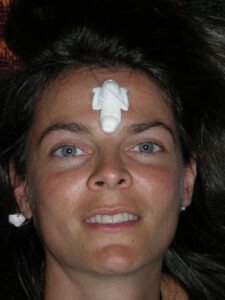
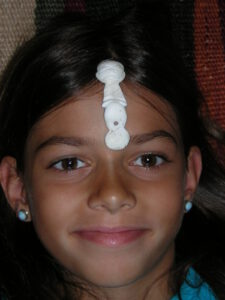
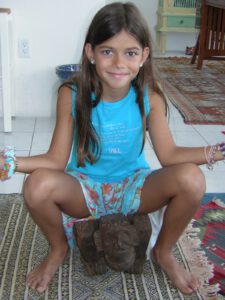
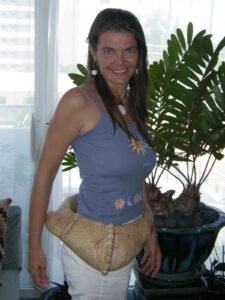
Items from Alfred Carrada’s private collection: forehead pendants; duho or ceremonial wooden seat; stone belt.
Bibliography
ALEGRIA, Ricardo E., “Notes on the mythology of the Taíno peoples of the Greater Antilles and their South American origins”, Centre for Advanced Studies of Puerto Rico and the Caribbean, Museum of the Dominican People, 1978.
ARROM, José Juan and GARCIA ARÉVALO, Manuel A., “The Bat and the Owl in Taíno Culture”, Ediciones Fundación García Arévalo, 1988.
ARROM, José Juan, “Fray Ramón Pané. Account of the Antiquities of the Indians. The First Treatise Written in the Americas. New edition with notes, map and appendices”, Siglo XXI Editores, 1974.
ARROM, José Juan, “Mythology and Pre-Hispanic Arts of the Antilles”, Siglo XXI Editores, 1975.
CARRADA, Alfred, “Some notes, remarks, observations, words and names on the language and culture of the Island-Arawaks commonly known as Tainos”, online, August 2003.
GARCIA ARÉVALO, Manuel Antonio, “Altos de Chavón Regional Archaeological Museum”, published by the Altos de Chavón Regional Archaeological Museum, 1982.
GALVÁN, Manuel de Jesús, “Enriquillo”, Ediciones de Cultura Hispánica, AECI, 1996.
HERNÁNDEZ DIAZ, Fernando, “Anacaona: Queen of the New World”, Corripio Publishers, 2003.
HERNÁNDEZ SOTO, Carlos, “Thus Spoke Grandfather Bayamanaco: Tales and Beliefs of the Taínos”, Burhen Publishers, 1985.
OLSEN, Fred, *On the Trail of the Arawaks*, University of Oklahoma Press, 1974 [originally published in 1891].
ORIOL, Michèle, *History and Civic Education*, Fondation pour la Recherche Iconographique et Documentaire, Port-au-Prince, 2001.
OVIEDO-LAS CASAS, “Selected Chronicles”, Library of Dominican Classics, vol. IV, Corripio Foundation Publications, 1988.
PAGAN PERDOMO, Dato, “New Pictographs on the Island of Santo Domingo: The Caves of Borbón”, Museum of the Dominican People, 1978.
PANE, Fray Ramón, “Account of the Antiquities of the Indians”, *Antología de Nuestra Voz* Collection No. 42, Casa Weber, 3rd ed., 2000.
PÉREZ DE OLIVA, Hernán, “History of the Discovery of the Indies. Study, edition and notes by José Juan Arrom”, Imprenta Patriótica del Instituto Caro y Cuervo, Bogotá, 1965.
POLANCO BRITO, Hugo, “Fray Ramón Pané, first teacher, catechist and anthropologist of the New World”, Museo del Hombre Dominicano, 1974.
PRIEGO, Joaquín, “Taíno Culture”, Santo Domingo, 2nd edition, 1971.
RODRÍGUEZ DEMORIZI, E., “Historical Accounts of Santo Domingo”, General Archive of the Nation, Montalvo Publishers, Ciudad Trujillo, vol. I, 1942.
RODRÍGUEZ DEMORIZI, E., “Historical Accounts of Santo Domingo”, General Archive of the Nation, Montalvo Publishers, Ciudad Trujillo, vol. II, 1945.
RODRÍGUEZ DEMORIZI, E., “Historical Accounts of Santo Domingo”, National Archives, Montalvo Publishers, Ciudad Trujillo, vol. III, 1957.
ROUSSE, Irving, “The Tainos: Rise and Decline of the People who Greeted Columbus”, Yale University, 1992.
SUED-BADILLO, Jalil, “Indigenous Women and Their Society”, El Gazir Publishers (Puerto Rico), 1975.
TAVARES, Juan Tomás, “The Indians of Quisqueya”, Santo Domingo Publishers Ltd, 1976.
TEJERA, Emilio, “Indigenisms”, Sociedad de Bibliófilos, Editora de Santo Domingo, 1977.
UGARTE, María, “Advises archaeologists in the Antilles to acquire knowledge of the Taíno language”, El Caribe, 1 March 1980, p. 12.
UGARTE, María, “The Taíno Influenced Contemporary Culture Far More Than Is Realised”, El Caribe.
VEGA, Bernardo, “Taíno Art”, Museum of the Dominican People.
VEGA, Bernardo, “Saints, Shamans and Zemíes”, Dominican Cultural Foundation, 1987.
VELOZ MAGGIOLO, Marcio, “Prehistoric Archaeology of Santo Domingo”, McGraw-Hill Far Eastern Publishers Ltd – Singapore, 1972.
VELOZ MAGGIOLO, Marcio and CABA FUENTES, Angel (eds.), “Proceedings of the First Caribbean Archaeology Seminar” – held from 15 to 22 August 1995 in Altos de Chavón –, Altos de Chavón Regional Archaeological Museum, 1996.